Pages

Wednesday, September 25, 2013

Print and Play Games

  I played a few print and play games for my game design class. The games were called micropul, Shape Up!, and Air Traffic Controller. Here's what I thought of them.

micropul (http://neutralbox.com/micropul/)

  This is a two player game that involves matching tiles together. Players gain points by collecting tiles and claiming groups of black and white dots that are formed as tiles are placed together. If you run out of tiles, then you lose. I enjoyed the logical aspect of the game, and I like how the game makes you carefully consider the spatial relationships of the tiles and how you can make the most of them. The main problem I had in the game was that someone would end up running out of tiles within the first few minutes, causing the game to end. There isn't too much satisfaction in winning just because your opponent ran out of tiles and vice-versa. Maybe this is something that gets better with more practice. A possible way to address this could be to give players a small starting supply of tiles so they don't run the risk of losing too early. This would at least be a good modification for beginners.


Shape Up! (http://www.goodlittlegames.co.uk/games/06-shape-up.html)

  This is a card game where players line up cards based on the displayed shape, color, and solidity or hollowness. At the start, players get a "victory card" with these aspects that he or she must try to line up on the board. It took me a while to understand the rules, as doing so involves breaking the mind's natural tendency to categorize things. Once you wrap your head around it, the game is interesting in the way it gets you to think about the shapes in the cards and line them up in unique ways to gain points. I feel like the concept of this game is difficult to convey in writing, and for that reason, I think the instructions should have made use of more pictures and graphics to more clearly get the idea across.


Air Traffic Controller (http://boardgamegeek.com/boardgame/29084/air-traffic-controller)

  In this game, you get to take on the exciting role of an Air Traffic Controller. The game comes with different scenarios with arrival and departure times for planes, as well as the terminals that they must go to and from. On each turn, the player can order a single plane to stop, continue, turn, or backup. Aircraft will collide if the player is not careful, in which case, he or she loses. My biggest issue with the game is how difficult it is to keep track of the plane movement, scenario actions, turn numbers, and points. Even though this is supposed to be a solitaire game, I think it would be better if there was another player who could be in charge of the scenario and points recording. The yellow text on the board is also very hard to read. I like the idea of the game though. I think it would be fun with a bigger map and more planes, as well as additional hazards on the tarmac. Of course, this would all make the game even more complicated, meaning there would definitely need to be some sort of score-keeper. In a way, though, the complexity of the game did help me sympathize with real air traffic controllers and the difficult job they have. Next time I am stuck waiting on a plane, I'll think back to my memories of playing Air Traffic Controller and realize that they are probably doing a better job than I could ever do.

Wednesday, September 18, 2013

B. F. Skinner

  In game design class, we have been looking at the effects of rewards on gameplay. We were asked to do some research on the psychologist B. F. Skinner. Skinner is notable for his innovation of a new philosophy of science called radical behaviorism. This theory is based in the idea of operant conditioning, where one's behaviors can be modified by their consequences. Central to all of this is Skinner's principle of reinforcement. In psychology, reinforcement is the strengthening of a behavior due to its association with a stimulus, as opposed to punishment, which weakens a behavior. Skinner's principle of reinforcement says that if the consequences are good, then one's actions will be reinforced, while if the consequences are bad, one's actions will be punished.

  Skinner tested his ideas in his "Skinner Box," more scientifically known as the operant conditioning chamber. This apparatus allows researchers to expose animal test subjects to stimuli like lights and sound signals. The chamber delivers a reward to the animal, such as food, after it successfully performs a behavior. These devices allow for experimentation in behavior and conditioning through reward and punishment mechanisms.

  I suppose the idea of the Skinner Box can be applied to game design and testing. Reinforcement and punishment can work very well in giving the game an interesting balance. For example, the game Dishonored makes good use of this idea by offering the player different sets of rewards and punishments depending on if they want to approach the game violently or nonviolently. A game is a lot like a Skinner Box. Players are conditioned by the rules and mechanics of the game, which they must follow in order to receive a reward. This means that there is a lot of potential for experimentation in the conditioning that a game allows, and by experimenting, maybe developers can find new ways to influence player motivations.

Sunday, September 15, 2013

Thoughts on Steve Hickner's Lecture

   I think Steve Hickner's lecture last week was a great introduction for me to some of the ideas behind storyboarding. He gave a list of storyboarding dos and don'ts, such as don't underboard, don't field too tightly, don't cutoff the characters in an awkward place (such as a joint), don't push the character or action too far out of the "golden egg" (this is an oval shape within the frame that characters should stay in to attract the viewer's attention), don't be afraid to move the camera, don't keep every shot at eye level, don't move everything (it's hard to create a single focal point when everything is moving) do watch eye trace, do separate planes tonally, do watch perspective. I haven't done much storyboarding or video editing before, so it was great to learn about these general guidelines.

   It was also great to see Steve Hickner's reworked versions of the CA senior storyboards. The storyboard revisions helped me to see how some of the story boarding theory presented can be put into practice. Something that I really liked was Hickner's attempts to give every shot a purpose within the context of the entire story. In one of the storyboards, he eliminated a setting to be replaced with a single recurring location. This serves the dual purpose of saving time by having to create one less scene, as well as making all of the events in the story more strongly connected.

  So overall I thought that this lecture was very informative. It was a great first look for me into the process of storyboarding and how to convey narrative to an audience. The next step for me is to start putting these ideas into practice in my own work to build a better understanding through experimentation.

Sunday, September 8, 2013

3D Game Environment Concept

     Here is the concept drawing I did for my environment idea in 3D class. The idea was a soviet mining town on an island in the Arctic Ocean. The story was that all of the people left their homes to travel to a strange tower structure that appeared out of the island's heavy fog. 

Wednesday, August 28, 2013

Some Drawings From Last Semester

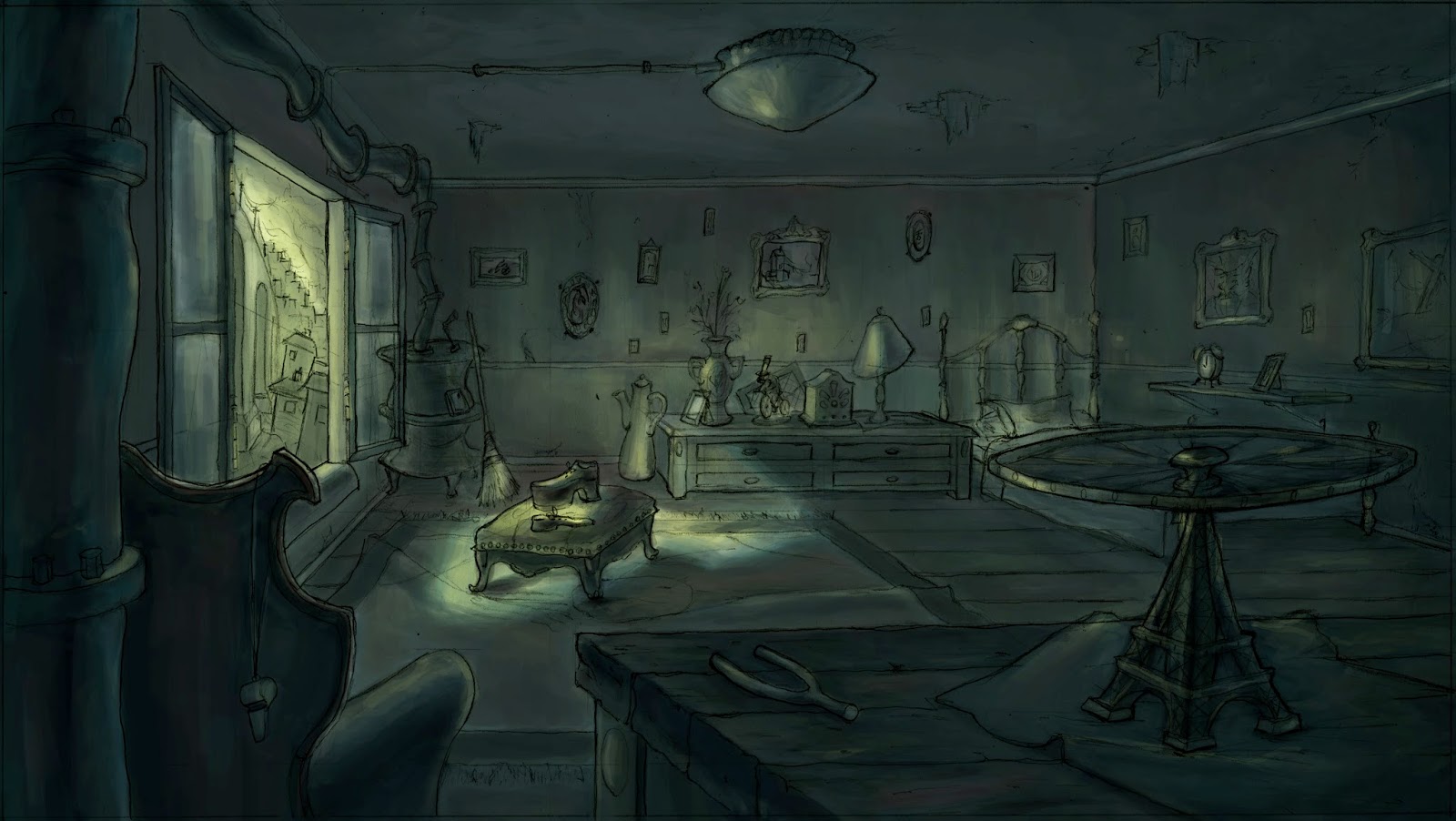
Here are a few drawings that I made last semester


I think one of the most vital things that I learned about in drawing II was the process of thumb nailing ideas and creating color and value roughs before approaching the final composition. This process makes a lot of sense to me personally and helps me stay more focused then if I was approaching a piece from a more freeform approach. I think drawing II was a great opportunity for me to work at improving my abilities with perspective, composition, color, and idea generation, and I'm determined to continue developing my skills in those areas.

Sunday, August 25, 2013

Game Trailer Analysis


Here is a series of game trailers that I personally enjoy: Dishonored - The Tales from Dunwall


     The interesting thing to me about these trailers is how they serve the purpose of exclusively showcasing the story and mood of the game without offering any information about the game play. Many would argue that the purpose of a game trailer is to show at least in someway how the game will be played. However, I personally think that these trailers are strengthened by the choice of not including any game play. In doing this, the creators of this trailer could more effectively create an animation that represents what the game is intended to feel like. The choice in making the visual style of these shorts so different from that in the actual game also allowed the creators to add their own unique interpretations as to what it feels like to experience the world of Dishonored.
    I think that the essential purpose of a game trailer should be to communicate to its audience the compelling experience that a game can offer. This experience can be communicated by showcasing the game play and story. I don't think that both of these elements must be shown in a trailer so long as it succeeds at enticing its viewers with evidence of an engaging experience. In limiting the scope of the information presented I think these trailers very effectively achieve their intended purpose of conveying to the viewers that the world of Dishonored has a very rich history and troubling conflicts that the player will explore through his or her own experience of the game. 

Thursday, May 2, 2013